
Table of Contents
Heat pump vs air conditioning systems both serve to regulate the temperature inside a building, but they differ in their heating methods.
A heat pump uses refrigerant to transfer heat from outside to inside, making it a more energy efficient option for both heating and cooling.
An air conditioning system only cools the air and requires a separate heating system.
Your decision between a heat pump and air conditioning system will depend on factors such as the climate in your area, your budget, and your energy efficiency goals.
⭐ Heat Pump vs Air Conditioning: Quick Comparison
Unsure which cooling system is right for you?
This at-a-glance comparison gives a quick rundown of how heat pumps and air conditioners compare.
| Feature | Heat Pump | Air Conditioner |
|---|---|---|
| Primary Function | Heating and Cooling | Cooling only |
| Energy Efficiency | High | Moderate |
| Average Installation Costs (including unit) | $4,700 to $13,500 | $3,400- $10,100 |
| Operating Costs | Lower (due to higher efficiency) | Higher, especially in hot climates |
| Climate Suitability | Best for moderate climates (heating and cooling) | Best for hot climates |
| Environmental Impact | Lower (no fossil fuels burned for heating) | Higher (energy consumption and refrigerant release) |
| Lifespan | 7.5-10 years | 15-20 years |
Now, let’s explore each system in more depth, starting with heat pumps.
⭐ What Is a Heat Pump?
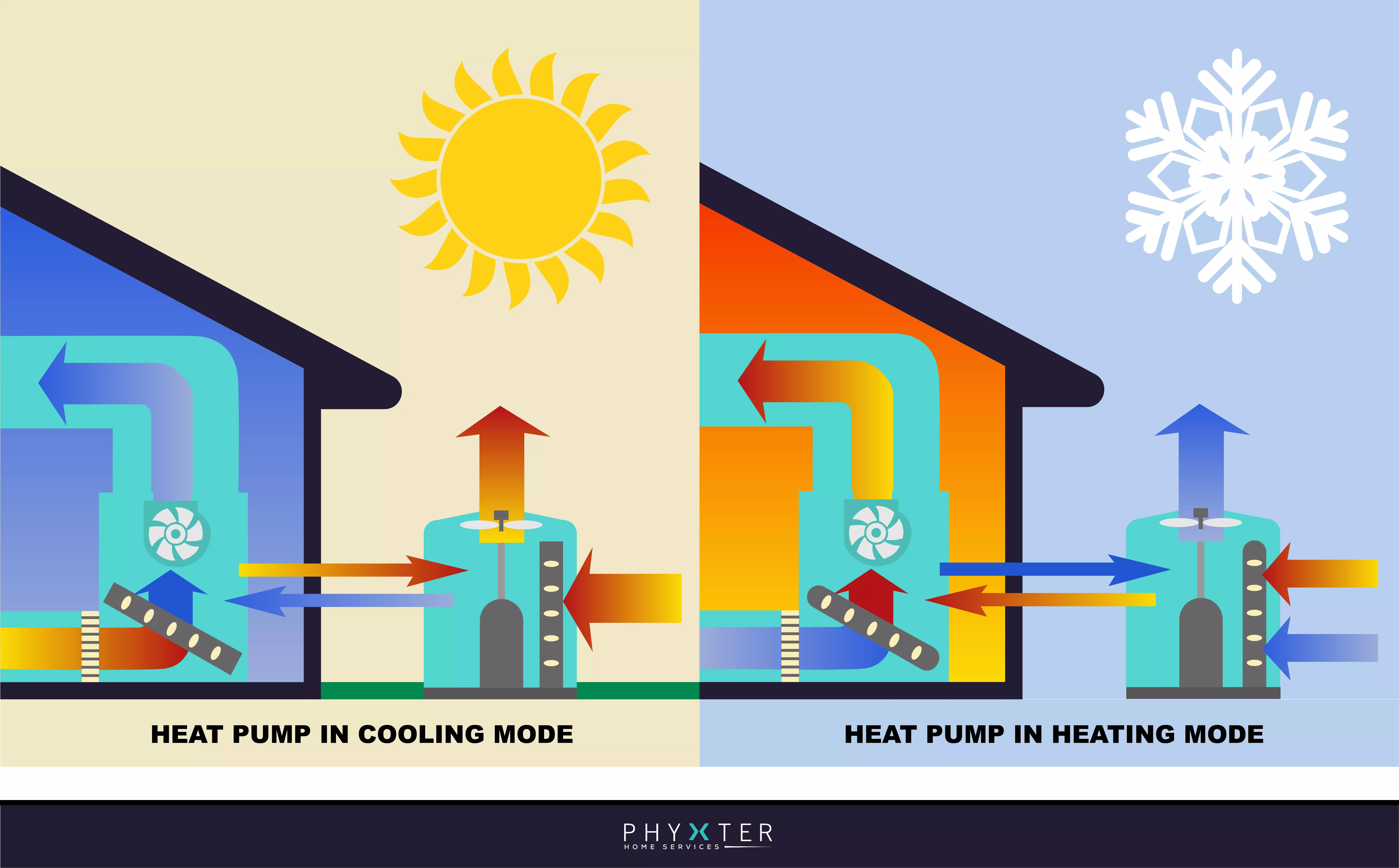
A heat pump is a cooling and heating system that uses energy to efficiently pump heat from one location to another.
It works by compressing, evaporating, and condensing refrigerant, which absorbs and releases heat as it changes state from liquid to vapor.
The heat pump cycle consists of four main components:
Compressor – Pressurizes the refrigerant, raising its temperature.
Condenser – Releases heat from the refrigerant to the desired space.
Expansion valve – Reduces pressure on the refrigerant, cooling it down.
Evaporator – Absorbs heat from the surrounding air or ground into the refrigerant.
In cooling mode, the heat pump extracts heat from inside your home and expels it outside. In heating mode, it reverses this process, extracting heat from the outside air (even cold air) and bringing it inside.
Heat pump systems can be used for heating, cooling, and hot water production.
They are commonly used in homes as an alternative to traditional heating and cooling systems and are known to be particularly efficient in mild climates.
With recent technology improvements, they can now efficiently operate in temperatures as low as -30 degrees Fahrenheit (-34°C).
⭐ Pros & Cons of Heat Pumps
There are several pros and cons to using a heat pump.
✔ Pros of a Heat Pump
Energy efficient: Heat pumps can be up to 300% efficient or higher, meaning for every watt of electricity used, 3 watts of heat would be generated.
This is called their coefficient of performance (COP).
To put it in perspective, an electric baseboard heating system is 100% efficient.
Heat pumps are considered one of the most energy-efficient heating systems on the market today.
Flexibility: Heat pumps work both as a heating and cooling system, making them a versatile option for all-in-one climate control.
Keep in mind that it is usually recommended that you have a backup heat source.
Lower operating costs: Heat pump heating uses less energy than traditional electric heating and cooling systems, which have lower operating costs over time.
Comparing heat pumps to natural gas furnaces would require localized pricing data.
Environmentally friendly: Heat pumps do not burn fossil fuels to create heat, which means their heating cycle does not produce carbon emissions.
This is not to be said that they are carbon neutral, as that would require the manufacturing and delivery process to be carbon neutral as well.
Flexible zoning: Heat pumps, especially ductless mini-splits, offer great zoning capabilities.
You can connect multiple indoor units to one outdoor unit, letting you control temperatures in different rooms independently.
So you can keep your bedroom cool while the living room stays warm, potentially saving energy by only heating or cooling the spaces you’re using.
❌ Cons of Heat Pump
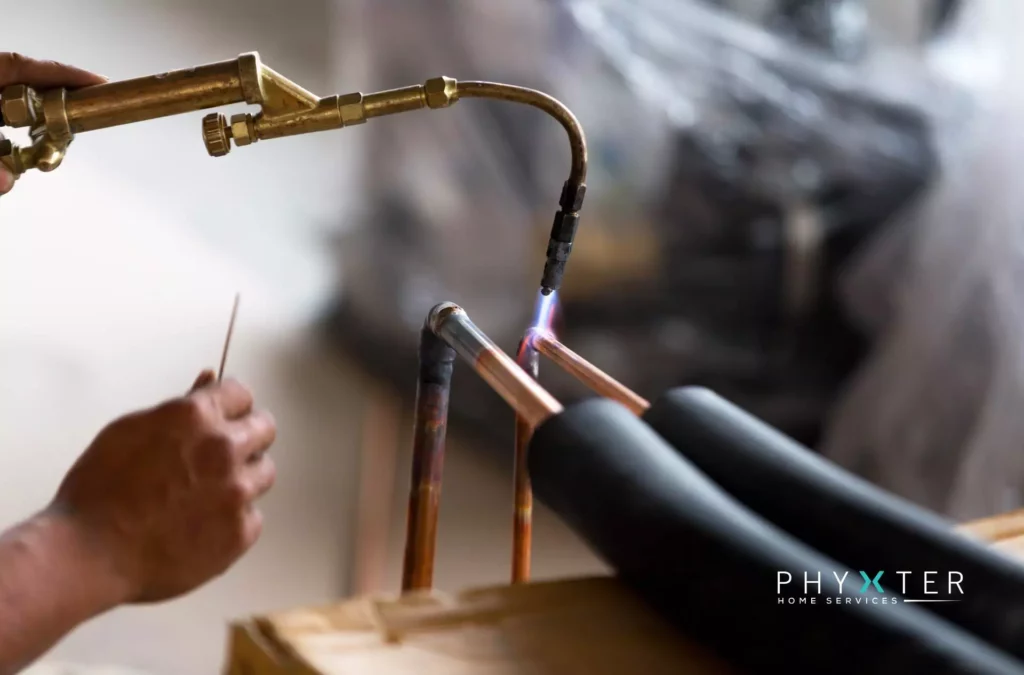
Initial cost: Heat pumps can be more expensive to purchase than traditional heating and cooling systems.
This is generally because they are more efficient and require more technology to operate.
A true cost comparison would need to take all factors into consideration.
Limited efficiency in extremely cold weather: Heat pumps lose efficiency as the temperature decreases, and may require supplementary heating.
With that said, there are cold climate heat pumps that maintain full efficiency down to around -15°F (-26°C).
Size and noise: Some heat pumps can be large and noisy, which may be an issue for some people. However, this wouldn’t be any different than an air conditioner.
Also, the inverter technology used in high-efficient cold climate heat pumps leads to operating with decibel ratings as low as 50.
✅ PRO TIP: The above list is not exhaustive and the efficiency, costs, and suitability of a heat pump may vary depending on the specific model, location, and climate.
It’s recommended to discuss your specific needs with a professional HVAC contractor before making a decision.
⭐ What Size Heat Pump Do You Need?
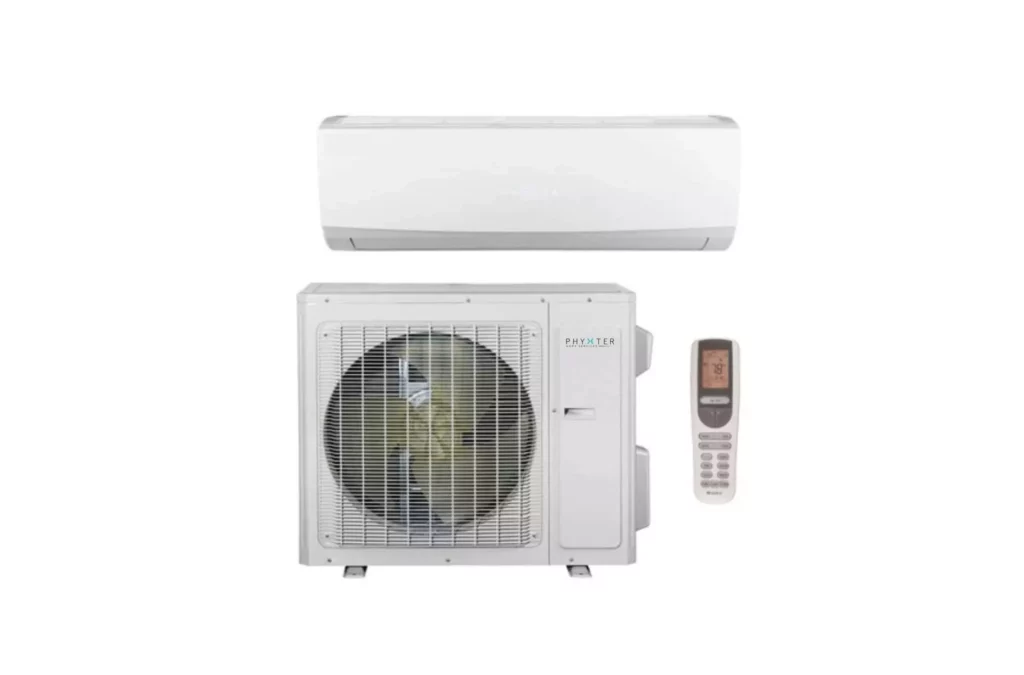
The size of the heat pump you need depends on several factors, including the size of your home, the quality of your insulation, the climate you live in, and your personal heating and cooling preferences.
A general rule of thumb is to have a heat pump that is properly sized for your home.
An oversized unit will cycle on and off frequently, which can lead to decreased efficiency and increased wear and tear.
An undersized unit will struggle to maintain the desired temperature, leading to increased energy usage.
A heat load calculation is the most accurate way to determine the size of the heat pump you need.
This heat load calculation will take into account the insulation levels, window size and location, and heating and cooling requirements of your home to determine the correct size of a heat pump.
Certified HVAC contractors or engineers can perform a heat load calculation for you.
The heat load calculation will also take into account the Climate zone in which you live.
This plays a huge role in determining the size of the heat pump you need.
For example, a smaller heat pump may be sufficient if you live in a region with mild winters.
But if you live in a region with very cold winters, a larger heat pump may be needed to heat your home efficiently.
⭐ What is an Air Conditioner?
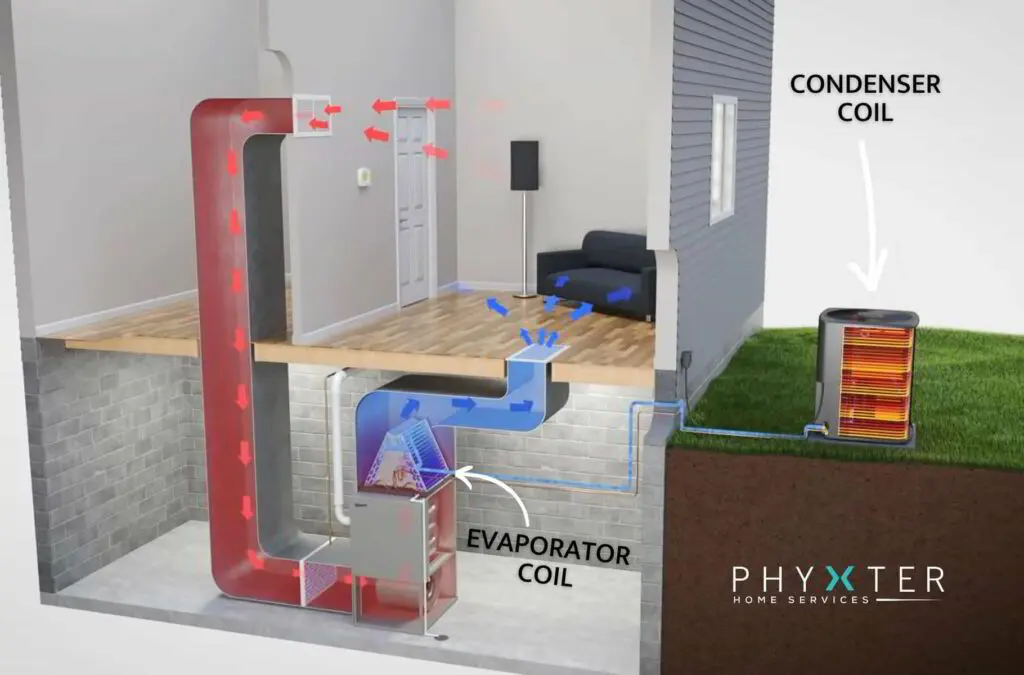
An air conditioner is a cooling system that is used to cool and dehumidify the air in a building or vehicle.
AC systems work by absorbing heat and moisture from the air, discharging that heat outside, and circulating the dehumidified and cold air throughout the space.
There are different types of air conditioners, including central air conditioners, window air conditioners, and portable air conditioners.
Central air conditioners are typically used in larger buildings and homes and are connected to a network of ducts that distribute the cooled air.
Window air conditioners are typically used in smaller spaces and are installed in a window or through a wall.
Portable air conditioners can be moved from room to room and are typically used in smaller spaces or as a supplement to a central AC system.
Air conditioners work by using a refrigerant, which is a substance that absorbs heat as it evaporates, and releases heat as it condenses.
The refrigerant is compressed and expanded by a compressor and a system of coils, which causes it to change state between vapor and liquid to absorb or release heat.
This process is known as the refrigeration cycle.
The main components of an air conditioning system include:
Evaporator – Located inside the house, it contains cold refrigerant that absorbs heat from indoor air.
Compressor – The heart of the system pressurizes the refrigerant, raising its temperature.
Condenser – Located outside, it releases the heat absorbed from indoors to the outside air.
Expansion valve – Controls the flow of refrigerant into the evaporator.
Thermostat – Monitors room temperature and signals the system when to turn on or off.
Air handler – Contains the fan that circulates air through the system and your home.
These components work together in the refrigeration cycle.
The evaporator absorbs heat from your home’s air, the compressor pressurizes the heated refrigerant, the condenser releases this heat outside, and the expansion valve reduces the refrigerant’s pressure before it returns to the evaporator.
This cycle continues until your home reaches the desired temperature set on the thermostat.
It is important to note that an air conditioning system uses a significant amount of energy to cool and dehumidify the air, and regular maintenance is important to keep the unit running efficiently.
❔ Have you answered your question yet, heat pump vs ac? If not, there’s tons of great information still to come.
⭐ Pros & Cons of Central Air Conditioning
There are several Pros and Cons to air conditioning.
✔ Pros of Air Conditioning
Comfort: ACs can greatly improve the comfort of a home by cooling and dehumidifying the air.
Health: ACs can help to reduce the risk of heat-related illnesses and can also help to reduce symptoms of allergies and asthma by filtering the air.
Productivity: ACs can help improve productivity by keeping the air in a home or building at a comfortable temperature and humidity level.
Energy-efficient models available: Nowadays, there are energy-efficient models of air conditioners available, which can help to reduce energy consumption and costs.
✅ PRO TIP: There are a lot of air conditioning myths out there, so be careful what you believe.
✔ Cons of Air Conditioning
Energy consumption: ACs can consume a significant amount of energy, which can lead to increased energy costs.
Initial cost: ACs can be expensive to purchase and install, especially if you’re looking for a more efficient system.
Regular maintenance: Central air conditioning systems require regular maintenance to keep them running efficiently, which can add to the overall cost of ownership.
📝 Note that AC maintenance is not difficult and can be easily completed by most homeowners.
Environmental impact: An air conditioner can have an environmental impact due to the energy consumption and release of refrigerant.
📝 Note that most refrigerants are not ozone-depleting.
Noise: Some models of ACs can be noisy, which can be disruptive.
Dry air: ACs can sometimes over-dehumidify the air, leading to excessively dry conditions that may cause skin irritation, respiratory issues, or static electricity.
📝 Note that this can often be remedied by proper system sizing and using a humidifier if necessary.
✅ PRO TIP: The above list is not exhaustive and the efficiency, costs, and suitability of an air conditioner may vary depending on the specific model, location, and climate.
It’s recommended to consult with an experienced HVAC contractor before making a decision.
⭐Heat Pump vs Air Conditioning – How Similar Are They?
Heat pumps and ACs are similar in that they both use the refrigeration cycle to transfer heat energy from one place to another.
The refrigeration cycle involves the use of a refrigerant, which is a substance that absorbs heat as it evaporates and releases heat as it condenses.
Both a heat pump and an Air Conditioner use a compressor in the outdoor unit and a system of coils to compress and expand the refrigerant, causing it to change state and absorb or release heat.
In an air conditioner, the refrigerant is used to absorb heat from the air inside a building or vehicle and transfer it outside.
In a heat pump, the refrigerant is used to absorb heat from the air or ground outside a building and transfer it inside.
Both heat pumps and ACs also have a filter in the air handler portion that helps to remove dust, pollen, and other particles from the air, improving air quality.
Most heat pumps and air conditioners require regular maintenance to keep them running efficiently, and both have an environmental impact due to the energy consumption and release of refrigerant.
In summary, heat pumps and air conditioning systems are similar in that they both use the refrigeration cycle, have a compressor and a system of coils, and a filter to remove dust and other particles, and both require regular maintenance.
The main difference is that heat pumps can provide both heating and cooling, whereas ACs are used for cooling only.
⭐ What are the Differences Between a Heat Pump and an Air Conditioner?
There are several key differences between air source heat pumps and air conditioners:
- Function: The main difference is that a heat pump can provide both heating and cooling, whereas an air conditioner is used for cooling only.
- Efficiency: In general, heat pumps are more energy efficient than air conditioners in the refrigeration cycle. This is solely because heat pumps need to be more efficient to heat a space during colder outside air temperatures.
- Climate: Heat pumps are generally better suited to climates that have moderate heating and cooling needs, as they can provide both heating and cooling. Air conditioners are more suitable for climates with high cooling needs and mild heating needs.
- Cost: The initial cost of a heat pump can be higher than an air conditioner, but the long-term cost may be lower because of the energy savings.
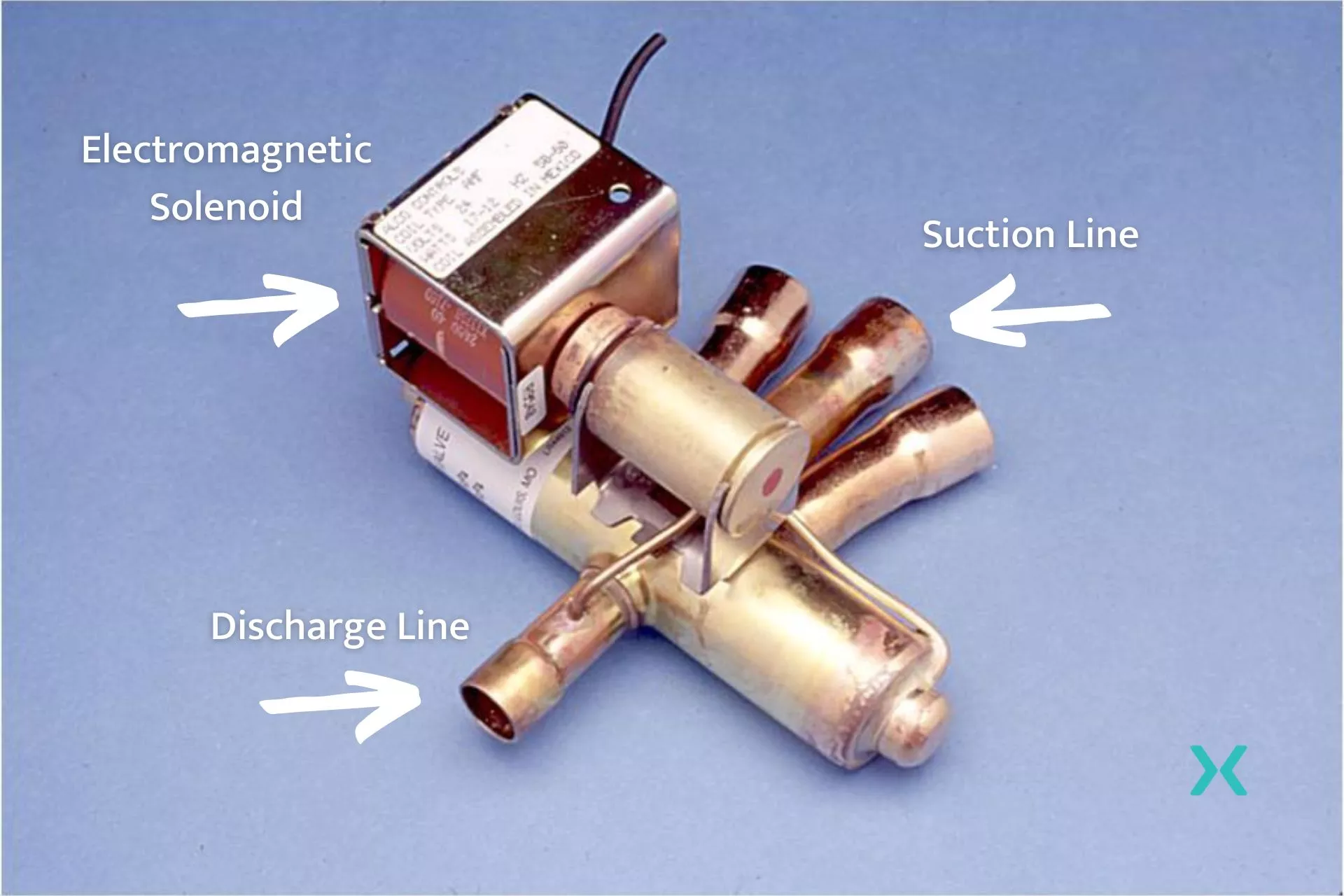
- Internal Components: Heat pumps have all of the same components as a central air conditioner, except they also have a more complex control board as well as a reversing valve in the outdoor unit.
⭐ Heat Pump vs AC – Which System is Right For You?
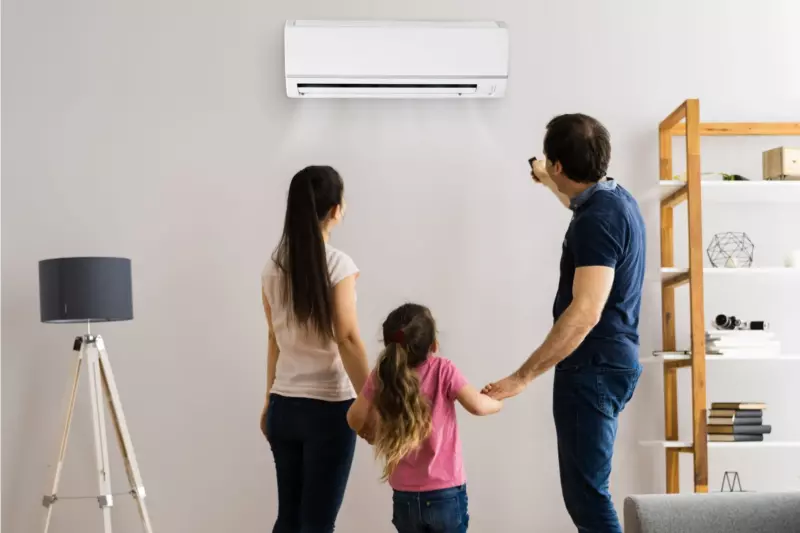
In the battle of Heat Pump vs AC, which system is right for you depends on several factors, including:
- Climate: A heat pump is generally better suited to climates with moderate heating and cooling needs, as they can provide both heating and cooling. An air conditioning system is more suitable for climates with high cooling needs and mild heating needs.
- Energy efficiency: If energy efficiency is a priority for you, heat pump efficiency may be a better option as it can be more energy efficient than an air conditioner when it comes to heating a space.
- Cost: The initial cost of a heat pump system can be higher than an air conditioner, but the long-term cost may be lower because of the energy savings.
- Space requirements: Heat pumps typically require more complex installation than air conditioners, so you should consider whether you have the space for this type of system.
- Noise: If you’re sensitive to noise, you should consider whether the heat pump or air conditioner you’re considering is known to be quiet.
- Personal preferences: If you want to have the option of both heating and cooling in your home, a heat pump system may be a better choice. If you live in a hot climate and only want to cool your home, an air conditioner might be a more suitable option.
It’s recommended to consult with a professional heating and cooling company to help you determine the best option for your specific needs and location.
They can also provide you with a detailed estimate of the costs, including the installation and operating costs.
🏡 Heat Pump vs Air Conditioner: Choices for Different Climates
☀️The Sunbelt Dweller
- Hot, humid climate (e.g., Florida, Gulf Coast)
- Long, hot summers with mild winters
- A high-efficiency air conditioner might be your best bet. While a heat pump could work, you’d rarely use its heating function, so the extra cost might not be justified.
🍁The Four-Seasons Homeowner
- Moderate climate with distinct seasons (e.g., Mid-Atlantic states)
- Hot summers and cool, but not extreme, winters
- A heat pump would be ideal. It’ll efficiently cool your home in summer and heat it in winter without the need for a separate furnace.
⛰️The Mountain Dweller
- Cold climate with mild summers (e.g., Rocky Mountains)
- Long, cold winters and short, mild summers
- A cold-climate heat pump could work well, especially when paired with a backup heating system for extremely cold days. Traditional AC might be overkill for the brief summer.
🏜️ The Desert Homeowner
- Hot, dry climate (e.g., Southwest)
- Very hot summers, mild winters, low humidity
- An efficient air conditioner is needed. Consider one with a two-stage compressor to handle extreme heat. A heat pump could work, but it might not be necessary unless you need heating in winter.
🌊 The Coastal Resident
- Mild, humid climate (e.g., Pacific Northwest)
- Mild temperatures year-round, but high humidity
- A heat pump could be perfect. It’ll provide the slight heating and cooling you need, and it’ll help dehumidify your home.
✔ Energy Efficiency and Cost Analysis
The amount of energy a 16 SEER heat pump or air conditioning unit uses will depend on several factors, including the size of the unit, the climate and weather conditions, and how often the heat pump is used.
Heat pumps measure efficiency in SEER or Seasonal Energy Efficiency Ratio, which is a measure of cooling efficiency.
The higher the SEER rating, the more efficient the heat pump is. A 16 SEER heat pump is relatively efficient compared to lower SEER units.
Generally, heat pumps range in efficiency from 14 SEER to 28 SEER.
A general rule of thumb is that a 1.5-ton 16 SEER heat pump will use approximately 3.5 kW per hour of electricity, and a 3-ton unit will use approximately 5 kW per hour.
This means, for example, that a 1.5-ton 16 SEER heat pump running for 8 hours a day would use approximately 28 kW/day. With a COP of 3:1, the heat pump in this example would produce 84kW/day of heat energy.
Please note that these are rough estimates, and actual energy usage will depend on a variety of factors, such as the unit’s sizing, the climate, and how often the heat pump is used.
To get a more accurate estimate of the energy usage of your specific heat pump, you can use an energy cost calculator.
Additionally, you can check the unit’s data plate for more specific information about the unit’s energy consumption.
📊 Estimated Cost Breakdown
Let’s talk costs – but we’re painting with broad strokes here.
Your mileage may vary, so account for your location, the size of your home, local energy rates, and even how much you love cranking up the cool (or heat).
These numbers are a financial forecast rather than a pinpoint prediction. They’ll give you a ballpark idea of what to expect.
For Heat Pumps
Installation Costs:
- Average range: $3,500 – $10,000
- Factors affecting cost:
- Size of the unit
- Complexity of installation
- Ductwork modifications (if needed)
- Brand and efficiency rating
Maintenance Costs:
- Annual professional maintenance: $200 – $400
- DIY maintenance (filters, etc.): $20 – $100 per year
- Potential repairs over 10 years: $1,000 – $3,000
- Operational Costs:
- Average annual energy cost: $500 – $1,000
- Varies based on:
- Local electricity rates
- Climate
- Home size and insulation
- Usage patterns
Long-term Cost Considerations:
- Potential energy savings: 30% compared to traditional HVAC systems.
For Air Conditioners
Installation Costs:
- Average range: $2,500 – $7,500
- Factors affecting cost:
- Size of the unit
- SEER rating
- Ductwork requirements
- Brand
Maintenance Costs:
- Annual professional maintenance: $100 to $200 per visit
- DIY maintenance (filters, etc.): $25 to $150
- Potential repairs over 10 years: $1,000 – $3,000
Operational Costs:
- Average annual energy cost: $600 to $1,500
- Varies based on:
- Local electricity rates
- Climate
- Home size and insulation
- Usage patterns
✔ How Long Do Heat Pumps Last vs. an Air Conditioner?
The analogy I like to use when comparing the life expectancy of heat pumps vs ACs is that of a car adding miles to the odometer.
If we’re assuming we’re comparing heat pumps and ACs at the same exact residence, then we can consider that all variables are equal.
So, if an AC only runs in the summer and heat pumps run year-round, we can make the determination that the heat pump is putting twice as many miles on it.
So, if the industry states that an AC will last 15-20 years, then it’s safe to assume that heat pumps should safely last between 7.5 and 10 years.
🔧 Extend Your HVAC’s Life
Heat pump or air conditioner – regular maintenance keeps it running smoothly and can add years to its life.
Don’t skip those annual check-ups. A professional can spot and fix small issues before they become big problems. Heat pumps might need this twice a year since they’re working double-duty.
Now, for your part. Make changing or cleaning your air filters a habit. It’s quick, easy, and makes a big difference in your system’s efficiency.
While you’re at it, take a look at your outdoor unit. Clear away any leaves, twigs, or debris that might be blocking airflow.
For heat pump owners, give those refrigerant lines a once-over now and then. Look for any damage to the insulation.
If you’ve got an AC, an annual cleaning of the condensate drain line can prevent clogs and water damage.
Here’s a pro tip: Consider upgrading to a programmable thermostat. It can help reduce unnecessary runtime, giving your system more rest and potentially extending its life.
And don’t forget about your home’s insulation—good insulation means less work for your HVAC system.
Regular care might seem like a chore, but it pays off in lower energy bills and fewer repairs down the line. And, a well-maintained system simply works better.
🧊 Additional Cooling Solutions to Consider
Ductless Mini-Splits
These flexible systems connect an outdoor unit to one or more indoor units, cooling separate zones without ductwork.
Evaporative Coolers (Swamp Coolers)
Popular in dry climates, these use water evaporation to cool air. They’re energy-efficient but work best in low-humidity areas.
Geothermal Heat Pumps
Making use of steady underground temperatures, these systems offer excellent efficiency for both heating and cooling.
Window Air Conditioners
The classic solution for single-room cooling, these units are affordable and easy to install, but lack the efficiency of central systems.
Portable Air Conditioners
These freestanding units can be moved from room to room, but aren’t the most efficient of solutions.
⭐ Final Thoughts on Heat Pumps vs. Air Conditioners

When choosing between a heat pump and a traditional air conditioner, it’s important to consider your home’s climate, energy goals, and year-round comfort needs. Always consult with multiple HVAC contractors; each may offer different perspectives and solutions tailored to your specific situation.
If you’re in the North Okanagan, the team at Vernon Air Conditioning, Plumbing & Electrical Services can help you evaluate the best system for your home. Contact us to discuss your options and ensure you’re making the most informed long-term investment in home comfort.